Appendix: Benchmarking Solvers
Benchmarks on simple test structures can be used for
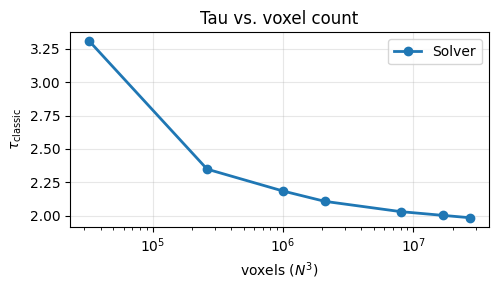
Investigation of convergence of the classical tortuosity factor with increasing voxel count. This addresses pixelation artifacts.
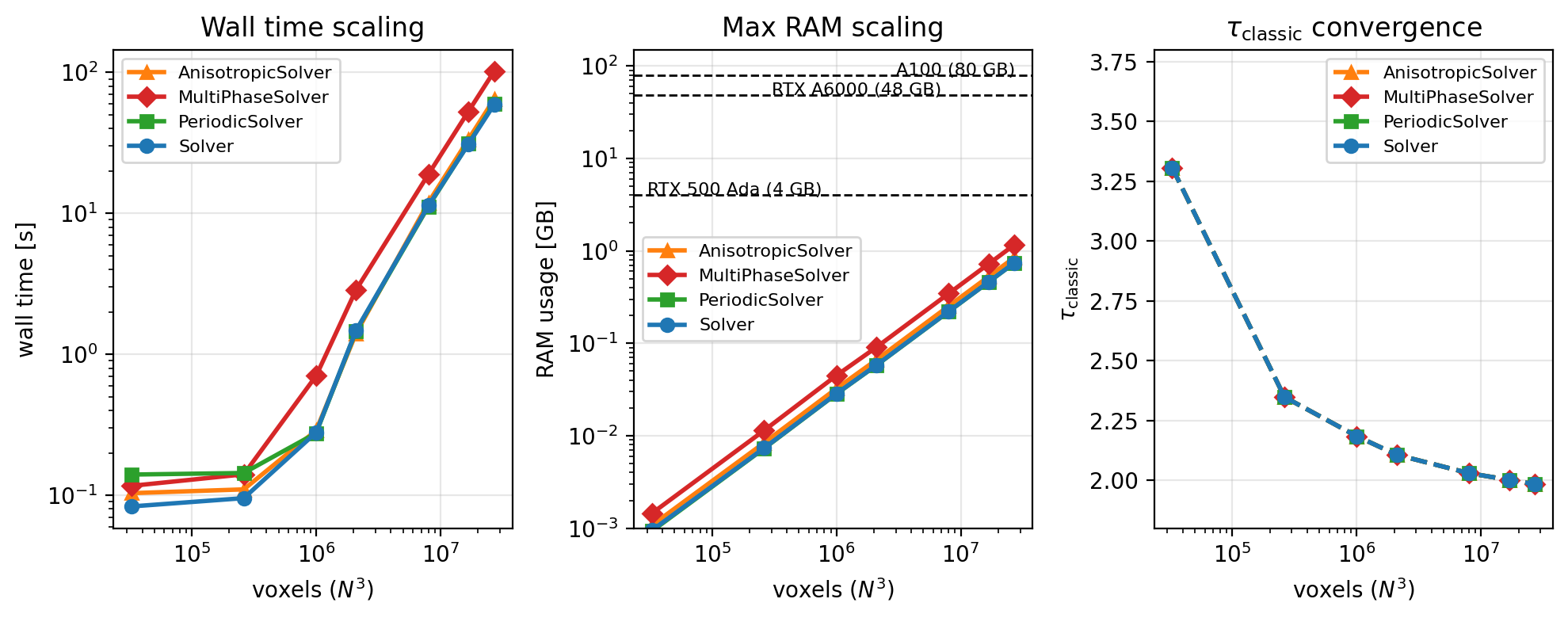
Cross-validation between various solvers to check consistency and different wall-time and RAM scaling (
Solver,PeriodicSolver,AnisotropicSolver,MultiPhaseSolver).
In utils.py, various test structures are predefined which can directly be called by the run_benchmark_study function in benchmark.py. We first visualise the various test structures…
[1]:
from taufactor.utils import create_fcc_cube, \
    create_stacked_blocks, create_2d_diagonals, \
    create_3d_diagonals, create_2d_zigzag
import matplotlib.pyplot as plt
import numpy as np

Nx = 16
fields = {}

fields["fcc"] = create_fcc_cube(Nx)
fields["blocks"] = create_stacked_blocks(Nx, features=1)
fields["2d_diagonals"] = create_2d_diagonals(Nx, features=1)
fields["2d_zigzag"] = create_2d_zigzag(Nx, features=1)
fields["3d_diagonals"] = create_3d_diagonals(Nx, features=1)

fig, axes = plt.subplots(nrows=1, ncols=5, figsize=(15, 4), dpi=100)
for i, structure in enumerate(fields.keys()):
    axes[i].remove()
    axes[i] = fig.add_subplot(1, 5, i + 1, projection='3d')
    axes[i].voxels(np.transpose(fields[structure], (2,1,0))==1, facecolors='gray', edgecolor='black', alpha=1.0)
    axes[i].set_zlim(0, Nx)
    axes[i].set_aspect('equal')
    axes[i].set_title(structure)
    axes[i].set_xlim(0, Nx)
    axes[i].set_ylim(0, Nx)
plt.tight_layout()
plt.show()
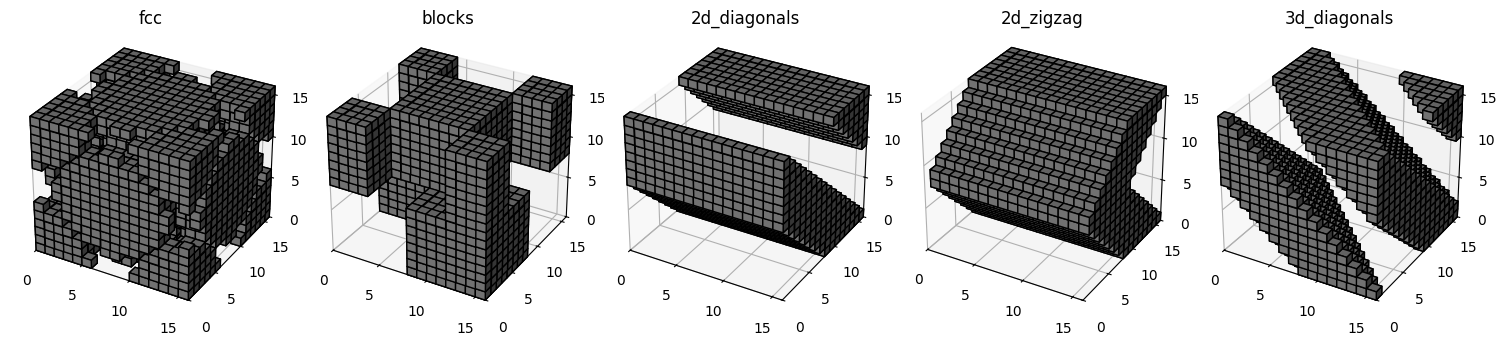
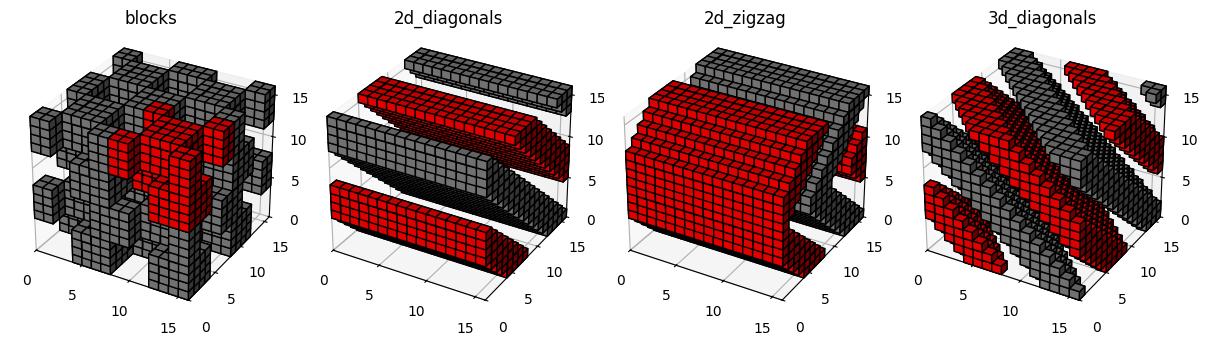
It is also possible to create the blocks, 2d_diagonals, 2d_zigzag and 3d_diagonals with multiple features in a repeating pattern e.g.
[2]:
from taufactor.metrics import label_periodic
from scipy.ndimage import generate_binary_structure

fields = {}
features = 2
fields["blocks"] = create_stacked_blocks(Nx, features=features)
fields["2d_diagonals"] = create_2d_diagonals(Nx, features=features)
fields["2d_zigzag"] = create_2d_zigzag(Nx, features=features)
fields["3d_diagonals"] = create_3d_diagonals(Nx, features=features)

fields["blocks"][Nx//2:,:Nx//2,Nx//2:] *= 2
connectivity = generate_binary_structure(3, 1)
fields["2d_diagonals"] = label_periodic(fields["2d_diagonals"], 1, connectivity, periodic=(False, True, True))[0]
fields["2d_zigzag"] = label_periodic(fields["2d_zigzag"], 1, connectivity, periodic=(False, True, True))[0]
fields["3d_diagonals"] = label_periodic(fields["3d_diagonals"], 1, connectivity, periodic=(False, True, True))[0]

colors = ['white', 'gray', 'red', 'blue', 'green']
fig, axes = plt.subplots(nrows=1, ncols=4, figsize=(15, 4), dpi=100)
for i, structure in enumerate(fields.keys()):
    axes[i].remove()
    axes[i] = fig.add_subplot(1, 5, i + 1, projection='3d')
    for j in np.unique(fields[structure]):
        if j>0:
            axes[i].voxels(np.transpose(fields[structure], (2,1,0))==j, facecolors=colors[j], edgecolor='black', alpha=1.0)
    axes[i].set_zlim(0, Nx)
    axes[i].set_aspect('equal')
    axes[i].set_title(structure)
    axes[i].set_xlim(0, Nx)
    axes[i].set_ylim(0, Nx)
plt.tight_layout()
plt.show()
Tau Convergence vs. Voxel Count on FCC cube
[3]:
from taufactor.benchmark import run_benchmark_study
import pandas as pd

Ns = [32, 64, 100, 128, 200, 256, 300]
res = run_benchmark_study(
    Ns=Ns,
    devices=['cuda'],
    conv_crit_values=[1e-3],
    structure='fcc',
    solver='Solver',
    write_file=False,
)

df_solver = pd.DataFrame(res).sort_values('N').reset_index(drop=True)
df_solver
[3]:
| N | structure | solver | device | conv_crit | total_time | solve_time | iterations | taufactor | torch_cur | torch_max | torch_res | |
|---|---|---|---|---|---|---|---|---|---|---|---|---|
| 0 | 32 | fcc | Solver | cuda | 0.001 | 0.232843 | 0.104405 | 400 | 3.307094 | 0.71 | 0.97 | 2.10 |
| 1 | 64 | fcc | Solver | cuda | 0.001 | 0.102649 | 0.082804 | 500 | 2.348118 | 5.45 | 7.54 | 27.26 |
| 2 | 100 | fcc | Solver | cuda | 0.001 | 0.359405 | 0.308809 | 800 | 2.184316 | 21.22 | 29.22 | 44.04 |
| 3 | 128 | fcc | Solver | cuda | 0.001 | 1.537179 | 1.453016 | 1000 | 2.106697 | 42.74 | 59.52 | 85.98 |
| 4 | 200 | fcc | Solver | cuda | 0.001 | 11.482289 | 11.105710 | 1500 | 2.029747 | 163.11 | 227.11 | 236.98 |
| 5 | 256 | fcc | Solver | cuda | 0.001 | 31.583841 | 30.962704 | 2000 | 2.001894 | 339.74 | 473.96 | 480.25 |
| 6 | 300 | fcc | Solver | cuda | 0.001 | 60.363106 | 59.183771 | 2400 | 1.984324 | 546.30 | 762.30 | 773.85 |
[4]:
fig, ax = plt.subplots(figsize=(5, 3), dpi=100)
x_voxels = df_solver['N'] ** 3
ax.plot(x_voxels, df_solver['taufactor'], marker='o', linewidth=2, color='#1f77b4', label='Solver')
ax.set_xscale('log')
ax.set_xlabel('voxels ($N^3$)')
ax.set_ylabel('$\\tau_\\text{classic}$')
ax.set_title('Tau vs. voxel count')
ax.grid(True, alpha=0.3)
ax.legend(loc='best')
plt.tight_layout()
plt.show()
Solver Cross-Comparison (Wall Time and RAM)
[5]:
solver_specs = [
    {'solver': 'Solver', 'label': 'Solver', 'solver_kwargs': {}},
    {'solver': 'PeriodicSolver', 'label': 'PeriodicSolver', 'solver_kwargs': {}},
    {'solver': 'AnisotropicSolver', 'label': 'AnisotropicSolver', 'solver_kwargs': {'spacing': (1.0, 1.0, 1.0)}},
    {'solver': 'MultiPhaseSolver', 'label': 'MultiPhaseSolver', 'solver_kwargs': {}},
]

all_rows = []
for spec in solver_specs:
    print(f"Running {spec['label']}...")
    rows = run_benchmark_study(
        Ns=Ns,
        devices=['cuda'],
        conv_crit_values=[1e-3],
        structure='fcc',
        solver=spec['solver'],
        solver_kwargs=spec['solver_kwargs'],
        outfile='fcc_benchmark_results.txt',
        write_file=True,
    )
    for r in rows:
        r['solver_label'] = spec['label']
    all_rows.extend(rows)

df_compare = pd.DataFrame(all_rows)
# df_compare
Running Solver...
Running PeriodicSolver...
Running AnisotropicSolver...
Running MultiPhaseSolver...
[6]:
colors = {
    'Solver': '#1f77b4',
    'PeriodicSolver': '#2ca02c',
    'AnisotropicSolver': '#ff7f0e',
    'MultiPhaseSolver': '#d62728',
}
markers = {
    'Solver': 'o',
    'PeriodicSolver': 's',
    'AnisotropicSolver': '^',
    'MultiPhaseSolver': 'D',
}

fig, (ax1, ax2, ax3) = plt.subplots(1, 3, figsize=(10, 4), dpi=200)
for label, g in df_compare.groupby('solver_label'):
    g = g.sort_values('N')
    x = g['N'] ** 3
    ax1.loglog(
        x, g['solve_time'], marker=markers.get(label, 'o'), linewidth=2,
        color=colors.get(label), label=label
    )
    ax2.loglog(
        x, g['torch_max']/1024, marker=markers.get(label, 'o'), linewidth=2,
        color=colors.get(label), label=label
    )
    ax3.semilogx(
        x, g['taufactor'], marker=markers.get(label, 'o'), linewidth=2,
        color=colors.get(label), label=label, linestyle='--'
    )

# Hardware reference lines when using CUDA
for x, y, txt in [(3e4, 4, 'RTX 500 Ada (4 GB)'), (3e5, 48, 'RTX A6000 (48 GB)'), (3e6, 80, 'A100 (80 GB)')]:
    ax2.axhline(y, color='black', linestyle='--', linewidth=1)
    ax2.text(x, y, txt, fontsize=8, color='black')

ax1.set_xlabel('voxels ($N^3$)')
ax1.set_ylabel('wall time [s]')
ax1.set_title('Wall time scaling')
ax1.legend(loc='best', fontsize=8)
ax1.grid(True, alpha=0.3)

ax2.set_xlabel('voxels ($N^3$)')
ax2.set_ylabel('RAM usage [GB]')
ax2.set_title('Max RAM scaling')
ax2.legend(loc='best', fontsize=8)
ax2.set_ylim(0.001, 150)
ax2.grid(True, alpha=0.3)

ax3.set_xlabel('voxels ($N^3$)')
ax3.set_ylabel('$\\tau_\\text{classic}$')
ax3.set_title('$\\tau_\\text{classic}$ convergence')
ax3.legend(loc='best', fontsize=8)
ax3.set_ylim(1.8, 3.8)
ax3.grid(True, alpha=0.3)

plt.tight_layout()
plt.show()
[7]:
summary = (
    df_compare.groupby('solver_label', as_index=False)
    .agg(
        wall_time_mean_s=('solve_time', 'mean'),
        wall_time_max_s=('solve_time', 'max'),
        ram_peak_MB=('torch_max', 'max'),
        max_iterations=('iterations', 'max'),
    )
    .sort_values('wall_time_mean_s')
)
summary
[7]:
| solver_label | wall_time_mean_s | wall_time_max_s | ram_peak_MB | max_iterations | |
|---|---|---|---|---|---|
| 3 | Solver | 14.767117 | 59.091109 | 762.30 | 2400 |
| 2 | PeriodicSolver | 14.917869 | 59.956331 | 760.20 | 2400 |
| 0 | AnisotropicSolver | 16.008609 | 64.687983 | 870.30 | 2400 |
| 1 | MultiPhaseSolver | 25.325081 | 101.644147 | 1192.92 | 2400 |
Multiphase Diffusivity Study
It is furthermore possible to create your own test geometries and run a benchmark study with them. To do so, you need to write a function and pass it to the benchmark study call. We combine this here with testing specifics of the multi-phase solver.
[8]:
from taufactor.utils import create_2d_zigzag

def multi_zigzag(Nx):
    geom = create_2d_zigzag(Nx, features=1)
    N2 = Nx // 2
    geom[:N2, :, :][geom[:N2, :, :] == 1] = 2
    return geom

all_rows = []
diffusivities = [0.1, 0.5, 1.0, 2.0, 10.0]

for c in diffusivities:
    rows = run_benchmark_study(
        Ns=[64],
        solver='MultiPhaseSolver',
        solver_kwargs={'diffusivities': {0:0, 1: 1.0, 2: c}},
        structure=multi_zigzag,
        write_file=False,
    )
    for r in rows:
        r['diffusivity'] = c
    all_rows.extend(rows)

df_ratio = pd.DataFrame(all_rows).sort_values('diffusivity').reset_index(drop=True)
df_ratio
[8]:
| N | structure | solver | device | conv_crit | total_time | solve_time | iterations | taufactor | torch_cur | torch_max | torch_res | diffusivity | |
|---|---|---|---|---|---|---|---|---|---|---|---|---|---|
| 0 | 64 | multi_zigzag | MultiPhaseSolver | cuda | 0.001 | 0.361350 | 0.309471 | 600 | 4.863471 | 8.54 | 11.69 | 29.36 | 0.1 |
| 1 | 64 | multi_zigzag | MultiPhaseSolver | cuda | 0.001 | 0.226141 | 0.173996 | 500 | 1.808737 | 8.54 | 11.69 | 29.36 | 0.5 |
| 2 | 64 | multi_zigzag | MultiPhaseSolver | cuda | 0.001 | 0.149334 | 0.128130 | 400 | 1.607159 | 8.54 | 11.69 | 29.36 | 1.0 |
| 3 | 64 | multi_zigzag | MultiPhaseSolver | cuda | 0.001 | 0.181795 | 0.151589 | 500 | 1.808737 | 8.54 | 11.69 | 29.36 | 2.0 |
| 4 | 64 | multi_zigzag | MultiPhaseSolver | cuda | 0.001 | 0.171382 | 0.153869 | 600 | 4.863406 | 8.54 | 11.69 | 29.36 | 10.0 |
The results of this first study show that the tortuosity factor of multiphase simulations depends on the ratio of diffusivities/conductivities. When \(D_a\) is kept at \(1\) and \(D_b\in[0.1, 0.5, 1.0, 2.0, 10.0]\), we observe a symmetry in \(\tau_\text{c}\) values.
In the next study, we create multiple diagonals, which are labelled as \(1\) and \(2\) (see the Figure above with grey and red features). Even though the effective diffusivity depends on the actual value of \(D_b\), the tortuosity factor does not and is, in this case of parallel conducting channels, a purely geometric quantity.
[9]:
from taufactor.utils import create_2d_diagonals

def multi_diagonal(Nx):
    geom = create_2d_diagonals(Nx, features=2)
    geom = label_periodic(geom, 1, connectivity, periodic=(False, True, True))[0]
    return geom

all_rows = []
diffusivities = [0.1, 0.5, 1.0, 2.0, 10.0]

for c in diffusivities:
    rows = run_benchmark_study(
        Ns=[64],
        solver='PeriodicMultiPhaseSolver',
        solver_kwargs={'diffusivities': {0:0, 1:1, 2:c, 3:1, 4:c}},
        structure=multi_diagonal,
        write_file=False,
    )
    for r in rows:
        r['diffusivity'] = c
    all_rows.extend(rows)

df_ratio = pd.DataFrame(all_rows).sort_values('diffusivity').reset_index(drop=True)
df_ratio
[9]:
| N | structure | solver | device | conv_crit | total_time | solve_time | iterations | taufactor | torch_cur | torch_max | torch_res | diffusivity | |
|---|---|---|---|---|---|---|---|---|---|---|---|---|---|
| 0 | 64 | multi_diagonal | PeriodicMultiPhaseSolver | cuda | 0.001 | 0.239640 | 0.220841 | 500 | 2.010120 | 8.54 | 11.69 | 29.36 | 0.1 |
| 1 | 64 | multi_diagonal | PeriodicMultiPhaseSolver | cuda | 0.001 | 0.260428 | 0.235632 | 500 | 2.010121 | 8.54 | 11.69 | 29.36 | 0.5 |
| 2 | 64 | multi_diagonal | PeriodicMultiPhaseSolver | cuda | 0.001 | 0.241486 | 0.218591 | 500 | 2.010121 | 8.54 | 11.69 | 29.36 | 1.0 |
| 3 | 64 | multi_diagonal | PeriodicMultiPhaseSolver | cuda | 0.001 | 0.209310 | 0.188352 | 500 | 2.010121 | 8.54 | 11.69 | 29.36 | 2.0 |
| 4 | 64 | multi_diagonal | PeriodicMultiPhaseSolver | cuda | 0.001 | 0.208770 | 0.188987 | 500 | 2.010121 | 8.54 | 11.69 | 29.36 | 10.0 |
This multi-phase \(\tau_\text{c}\) value of \(2.01\) is identical to the result obtained with the PeriodicSolver and PeriodicMultiPhaseSolver for binary labelled channels (i.e. label 0 is isolating and label 1 has a diffusivity of \(D=1\)).
[10]:
all_rows = []
for solver in ['PeriodicSolver', 'PeriodicMultiPhaseSolver']:
    res = run_benchmark_study(
        Ns=[64], solver=solver,
        structure='diagonal2d', features=2,
        write_file=False,
    )
    all_rows.extend(res)
df = pd.DataFrame(all_rows).sort_values('N').reset_index(drop=True)
df
[10]:
| N | structure | solver | device | conv_crit | total_time | solve_time | iterations | taufactor | torch_cur | torch_max | torch_res | |
|---|---|---|---|---|---|---|---|---|---|---|---|---|
| 0 | 64 | diagonal2d | PeriodicSolver | cuda | 0.001 | 0.141711 | 0.125717 | 500 | 2.010121 | 5.38 | 7.47 | 27.26 |
| 1 | 64 | diagonal2d | PeriodicMultiPhaseSolver | cuda | 0.001 | 0.265061 | 0.246600 | 500 | 2.010121 | 8.54 | 11.69 | 29.36 |